Widgets, editor, explorer, master-detail

A generated form is easy to demo and hard to live with. The demo shows a text field appearing from a schema; the thing that decides whether the generator is useful is what happens when a field needs a different control, when one field has to influence another, when a record owns a list of children, or when the same data has to be edited as a permission matrix. Those are the cases where a generator either has an answer or sends you back to hand-written pages.
Blong's answers are all declared in the same place the page comes from: the widget a field gets, the method a widget may call back, the children a record owns, and the rows a matrix starts from.
One type decides the widget, in two places
The registry maps a widget type to a component — thirty-odd of them, from input and currency
through mask, chips, multiSelectTreeTable, navigator and imageUpload — and a suite adds
its own with one register call. What picks a type happens twice, and knowing both is what stops a
field from surprising you:
The first switch runs when the schema is loaded and stores its decision on the field; the second
runs when a card renders. The order is deliberate — an explicit extension beats the JSON type, which
beats a name — but the name heuristic is worth knowing about, because it is what turns a field
called discoveryDate into a date picker without anybody declaring it, and a field called
description into a textarea.
When the field is not enough
Two escape hatches sit at opposite ends of the same idea.
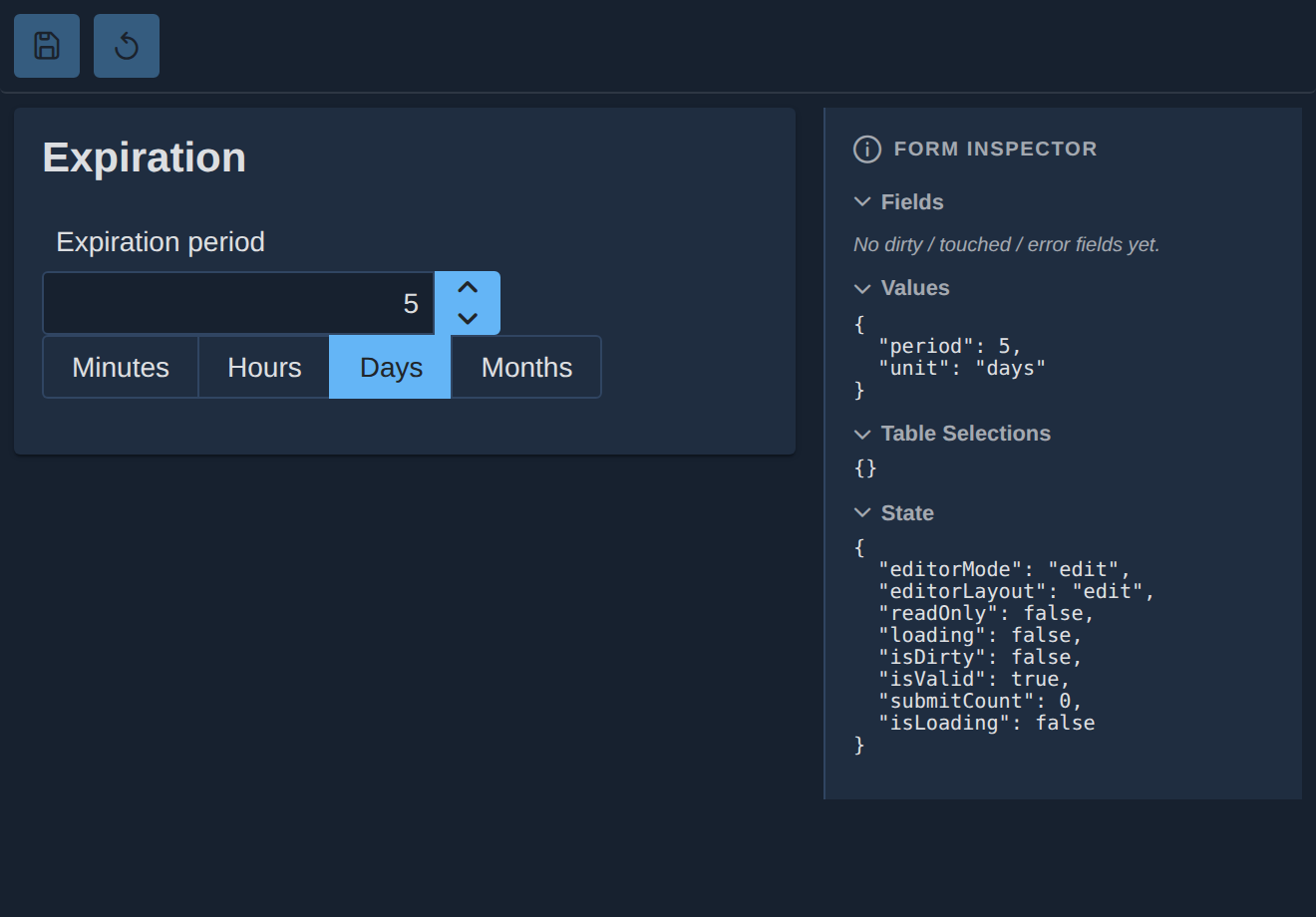
A custom widget is a component a realm hands to the form: it declares the fields it owns in a
properties array — so the layout can render them as one row — and receives factories for the
input, the label and the error. Here the smallest real one, from the Editor/CustomEditors story,
combines a period and a unit into a single control:
A field-change event is how a widget talks back. A field names a method, and the form's
methods map provides it; the method is awaited before the value is written, and receives the
field, the new value and the form's getters and setters. Returning false aborts the change, and a
thrown error is logged and the change dropped. That is enough for the case a generator cannot
express — a computed total, a field that must be recalculated, a value that has to be validated
against a sibling — without the widget knowing anything about the form it is in.
Children, two ways
A record with children is the classic place where generators give up. There are two mechanisms here, and they answer different questions.
The inline one is a detail card watching the selected row of a table in the same form: the widgets inside it read and write the selected row's fields, so editing a person's details happens next to the list of people. A polymorphic variant shows one card per kind of selected row.
The declared one is a model telling the generator the relationship exists:
details: [{object: 'credential'}, {object: 'role'}] on the user model expands into sibling
collections with their own tables, cards and tabs — and into the persistence shape at the other end.
The child rows come back with the master, add writes them, edit replaces them, and the
validation for that payload is generated from the same declaration. Deleting a master refreshes the
browse table and removes the children first, so a foreign key does not block the delete; deleting a
row inside an open form only edits the form until it is saved.
The matrix
A permission matrix is not a table with rows the user creates: the rows are the decision, and what
the user edits are the cells. A table widget declared as a pivot takes its rows from a static list
or from a dropdown, and join maps the seed row's key to the stored row's key so a saved cell lands
in the right place; defaults seeds a row the first time it is created. The access realm's user
model uses a dropdown pivot to edit role grants per target:
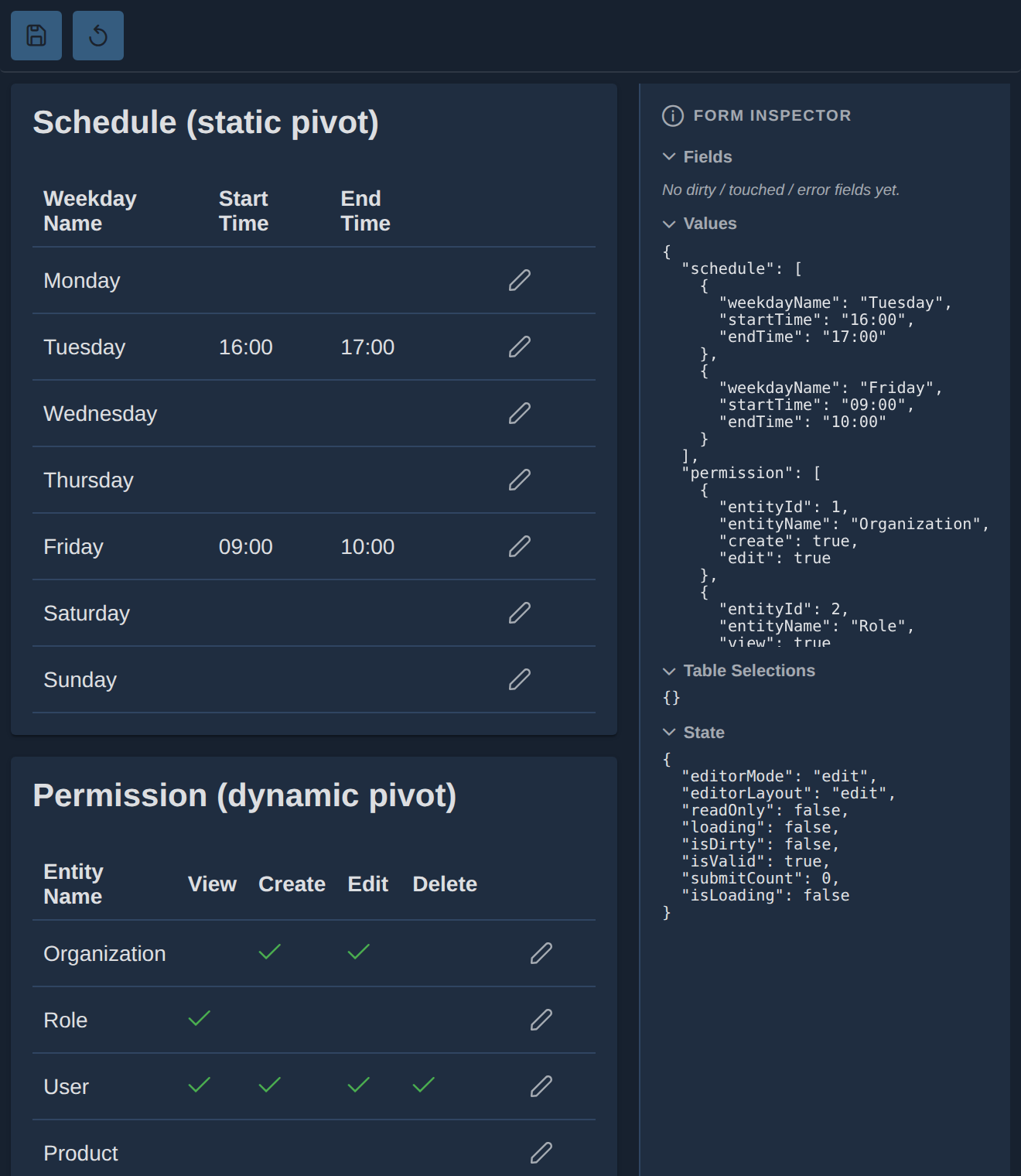
The limits are worth repeating because they are deliberate: a pivot has no Add, no Delete and no multi-select checkbox — its rows come from the declaration — and a pivot whose editable cells are all toggles is toggle-only. Writing one needs a handler that reconciles the whole array, since CRUD-shaped persistence does not know what a matrix means.
The explorer, and what made it fast
The generated browse page is an Editor in a split layout — a navigator, a table with a list
action, a detail panel, and actions on the toolbar. The Editor/Explorer stories write that
composition out by hand and supersede the older standalone Explorer's stories for generated pages;
the standalone component is still there for a page that wants a table and filters with nothing
around them.
Three defects were worth fixing in the framework rather than in a page, because every generated page inherited them. Typing a character re-rendered the editor and every widget (nobody needed those two state updates; the dirty flag comes from the form library). Saving wrote the submitted value and re-read the form, discarding server-side additions such as timestamps, where it now uses the response. And one context carried the values, the errors, the selections and the loading flags, so anything that changed re-rendered every consumer; it is split now, with the values reached through a getter instead of a subscription. The first two have regression tests that assert a sibling widget does not re-render when a field is typed into — a performance fix is only real once something fails when it regresses.
The catalogue, the two switches, the event contract and the pivot's limits are in the editor features concept; the page composition is in the blong-browser pattern, and the declaration that generates the pages in the model patterns.