Watch every process from one browser tab

A development run of Blong is never one process. There is a gateway, one or more realms, a browser bundle, a test run replaying the bug — each with its own terminal, each interleaved with hot-reload noise. The one line you need is somewhere in the middle of one of those windows, and the trace id that would tie the story together is buried inside it.
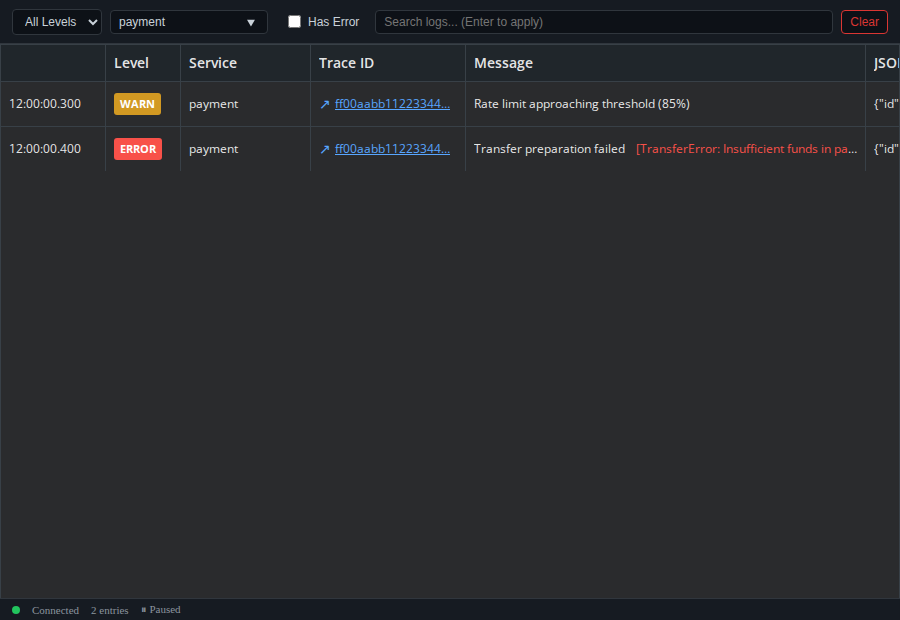
So we stopped tailing terminals. Every process ships its entries to one small server, and the server fans them out to a viewer in a browser tab. The tab is the log.
The shape: two transports and one server
On the emitting side, a pino transport batches entries and sends them over UDP. On the receiving side, a small server reassembles the batches, gives every entry an id, keeps the most recent ten thousand in a ring buffer, and exposes them two ways — a REST API for reads and a WebSocket for the live tail. The viewer is a grid that fetches recent entries once and then subscribes.
const logger = pino({
    transport: {
        target: '@feasibleone/blong-log/transport',
        options: {host: '127.0.0.1', port: 9999, batchSize: 10, flushInterval: 100},
    },
});
Why UDP, of all things
Everything else in this stack is ordered and reliable, so a connectionless datagram socket looks like the wrong instinct. For a hot path it is the right one, for three reasons.
Logging must not be able to slow down what it observes. A TCP write can block on a full window and a Unix socket can block on a full buffer; a UDP send back-pressures nobody. The transport is deliberately fire-and-forget — a failed send is swallowed, so a log call cannot fail a request it was only supposed to describe.
There is no connection to keep. The transport lives inside pino's worker thread: no handshake, no reconnect logic, no per-thread socket lifecycle to get wrong, and nothing to tear down when the process exits the way it exits.
Loss is acceptable here, and detectable. Each batch goes out with a twelve-byte header — a random eight-byte batch id, the packet index and the packet count — so the receiver can reassemble packets in order and drop an incomplete batch after a timeout instead of rendering half a line. The buffer is the last ten thousand entries, not a ledger: this is a development observer, and nothing in the request path reads from it.
The trace id is the join key
What makes the tab worth more than three terminals is one property: the trace id. Every entry
carries it, so it becomes a column, an exact filter and a click target — click it and the grid
narrows to that request across every process that handled it. In code you mostly do nothing for
this: the semantic logger binds a trace to the execution, propagates it between services in the
x-semantic-trace header while the call is in flight, and writes it on every record it emits.
The rest of the filtering is deliberately boring, and that is the point: level means "this level and above", the service name is a case-insensitive substring, the trace id is exact, and free text is a substring over the whole entry. Asking for "errors from the gateway mentioning timeout" is a query, not a grep across windows. Filters are applied twice — server-side for the WebSocket fan-out and client-side for immediate response — and they survive a reconnect.
What arrived later: the line that outlives the process
The viewer answers "what is happening now", and it forgets. A ring buffer kept in memory cannot answer "what did that line say before the process died" — which is exactly the question a failed test asks.
The second sink is an on-disk cache written by a second pino transport: every entry is stored under
its ULID, with the full record beside it. The ULID is what makes the two halves one story — the
printed line carries the id, and blong-dev log <ulid> fetches that entry from the cache long after
the process is gone. Clicking a semlog://r/<id> link in the editor's terminal opens it as a
document, which is the shortest path from a line in a terminal to the data behind it.
The operator reference — every REST parameter and the on-disk options — is in the log patterns, and the design reasoning in the real-time log rationale.