Commander: one explorer for every backend
Data stores are boring in the same way and different in the same ways: each has a hierarchy, a list of things at each level, a detail view, and its own client library. Writing a screen per backend means writing the same four screens six times, and the sixth one is where the keyboard handling regresses.
realm/blong-commander describes a backend as a source and lets one explorer render it. A
source is a namespace of triples — its name is the subject of every method it contributes — so
adding a backend is a configuration entry and, when the connection needs one, a small *Dev
adapter. There is no per-backend React.
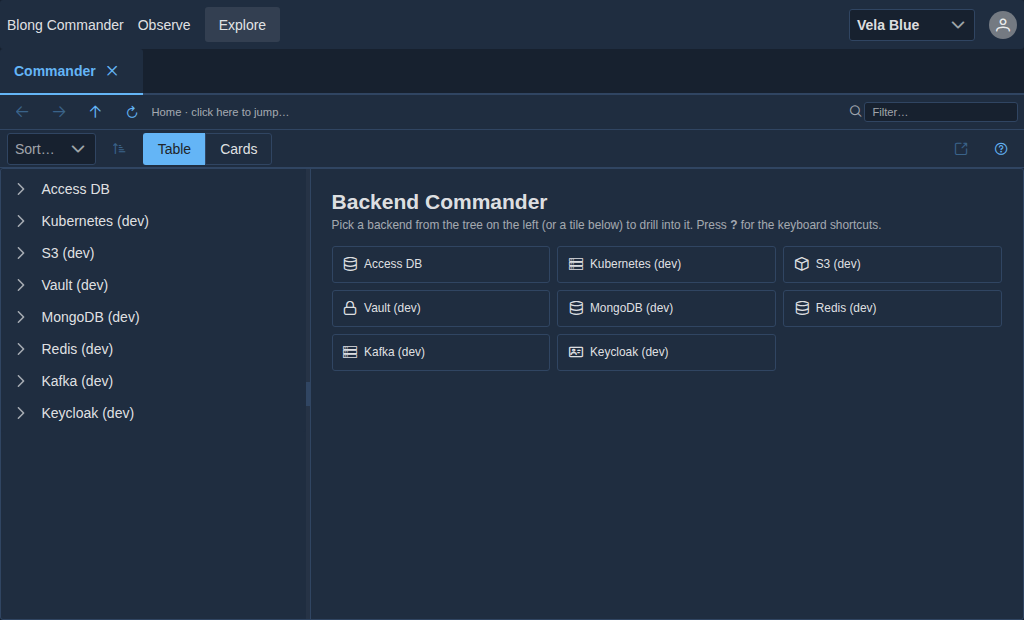
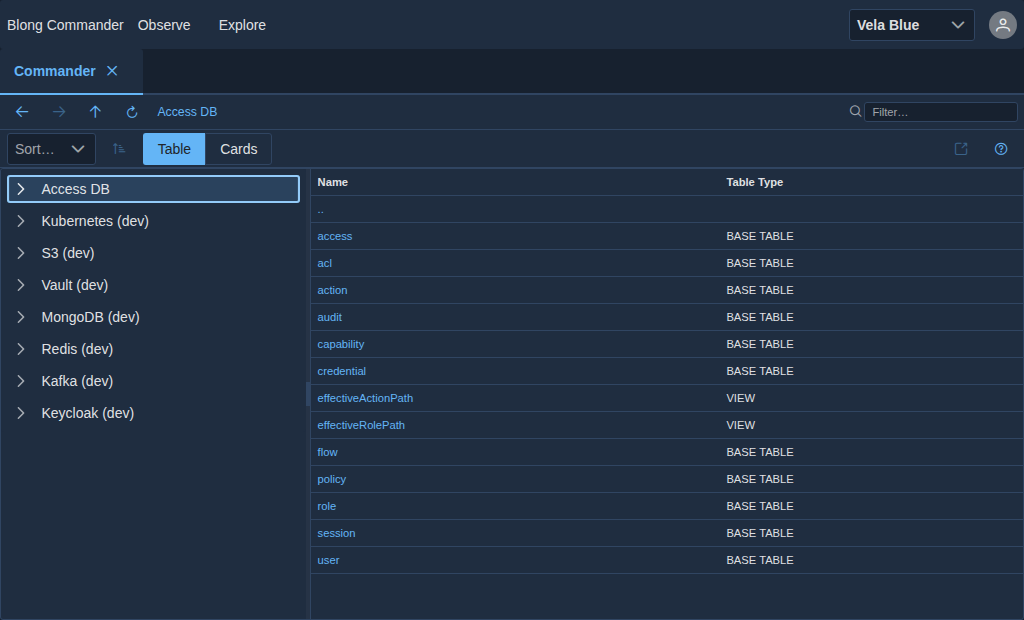
The source descriptor
export interface ICommanderLevel {
    label: string;
    list?: {method: string; params?: object}; // the list triple for this level
    open?: {method: string; params?: object}; // the detail triple, when the level has one
    permission?: string; // the action a caller needs to see this level
    viewer?: string; // which viewer renders a node of this level
    model?: ...; // declared, unused — see "What is not wired"
}

export interface ICommanderSource {
    name: string; // lowercase instance namespace — the subject of every triple
    label: string;
    icon?: string;
    permission?: string;
    levels: ICommanderLevel[];
}
The descriptors are a plain exported array — config/sources.ts — and the handlers read it as
(config).sources ?? defaultSources, resolve the level by index, and dispatch the level's list
method with params from the parent node. That is the whole abstraction: a hierarchy of levels
whose list and detail are existing triples. Nothing in the explorer knows what the backend is.
| Source | Backing implementation | Notes |
|---|---|---|
access-db | the shared srv.db adapter, through the access realm | the SQL source; no dedicated adapter |
k8s-dev | adapter.k8sDev → adapter.k8s | namespaces → categories → resources → item viewer |
s3-dev | adapter.s3Dev → adapter.s3 | buckets → objects; forcePathStyle for MinIO |
vault-dev | adapter.vaultDev → adapter.vault | mounts → secrets → secret viewer |
mongo-dev | adapter.mongoDev → adapter.mongodb | databases → collections → documents |
redis-dev | adapter.redisDev → adapter.redis | database index → keys |
kafka-dev | adapter.kafkaDev → adapter.kafka | topics → messages, in mode: 'admin' (metadata, not a stream) |
keycloak-dev | adapter.keycloakDev → adapter.keycloak | realms → users |
The *Dev adapters are local wiring, not a dev-only intent
Each *Dev adapter is a thin extension of the real adapter that supplies a local endpoint, local
credentials and the settings a local backend needs — Kafka's JSON codec and short session timeouts,
S3's path-style URLs. They declare activation.default, not activation.dev, and the framework
merges the default block in every intent: a production deployment that loaded this realm with its
own configuration would get these localhost endpoints unless it overrode them. The intended reading
is "dev-wired instance of the adapter", and a deployment supplies its own — the adapter is the unit
of reuse, and the realm's own index.ts decides which sources are listed.
The explorer
The shell lives in blong-browser (components/Commander/), not in the realm: the realm
contributes the descriptors, the handlers and a page that fetches them, and the component renders
whatever it is given.
- The tree is built from the source list, one root per source; a click resolves the level by position in the path.
- The list posts
{source, level, parent}tocommander.branch.list, which resolves the level'slisttriple and calls it. The handler flattens heterogeneous rows (a Kubernetes object and a SQL row are both objects) so one table can show either. - What a level shows is declarable, not only what its backend answers:
include(a whitelist) andexclude(a blacklist) hold regexes matched against the value the level displays —labelField, elsekeyField— and the same handler applies them before it orders the rows. The Kubernetes source uses it to show only the namespaces Kubernetes itself owns, because a cluster also lists whatever its own work created there and that set differs from cluster to cluster, so an unfiltered level made the tree read the cluster rather than the source. An absent or empty list means every row the backend answered with. - The filter is client-side over the flattened row, and the columns are derived from the data — scalar fields only. Nothing per-backend is configured for a table to appear.
- Opening a node is opt-in per level: a level with an
opentriple fetches the detail, a level without one shows its list row. - Viewers are keyed by resource type, not by backend:
resolveViewerpicks one from the node's metadata out of a registry that shipsjson,keyValue,file,image,table,document,secret,yaml,messageand pod-log viewers. A new backend reusing an existing shape gets its viewer for free.
Read-only, deliberately
There is no write path: no edit, update, save, delete or create handler exists
anywhere in the realm, and commander.node.action implements the read/navigation verbs (copyPath,
open, refresh). The explorer lists, filters, drills and views. Treat any statement that it edits
a backend as wrong — an admin tool that can mutate a production Kubernetes object or a Vault secret
needs an authorization story this realm does not attempt.
The observed-branch list
docs/observedBranchList.md is a generated artefact: a mermaid sequence diagram of
commander.branch.list's own dispatch — the handler's checkpoints at its side, the outgoing leg to
the access realm at the other. It is not a source and not a hand-written document; it is registered
in docs/blong/docs-artifacts.json and regenerated with the command recorded there. It is a good
example of the opposite of what it looks like: not "a non-CRUD source", but an orchestrator being
drawn, which is why the diagram has an alt branch for the shape the inner call returned.
What is not wired
Four things are declared but unused, and knowing them saves an afternoon:
commander.node.viewerandcommander.node.actionare not called by the browser. They are registered and gateway-validated, so they are reachable over RPC, but the shipped page usescommander.source.list,commander.branch.listandcommander.node.getonly.- The
commander.sourcesconfiguration override is not provided by any config, so the handlers always fall back to the hardcoded array. Overriding the source list from a suite therefore does not work yet, despite the comment incommanderDispatch.ts. ICommanderLevel.modelis used by no source and the page passes nomodelsprop, so the model-driven branch of the viewer resolution cannot fire in the shipped page.- Three of the eight sources have no
open— Kubernetes items, Kafka messages and Keycloak users render their list row rather than fetched detail.
Authorization
Sources and levels carry a permission, and commander.source.list prunes the tree by the caller's
effective actions before returning it — a source a caller cannot use is not a source they see. The
grants live with the realm: meta/dbTest/commander-accessAuthorizationMerge.yaml gives the Admin
role one action per source and level, and the level gating is fine-grained (s3Dev.object.list
gates one level while the source stays visible, and the k8s namespace gates a whole tree).
Adding a source
- Add an
ICommanderSourceentry toconfig/sources.ts: thenameis the triple subject, and each level names thelistmethod it dispatches. - If the connection needs one, add a
*Devadapter extending the real adapter, withactivation.defaultsupplying the local endpoint — and say in the header that a deployment overrides it. - Add the viewer if the resource shape is new, keyed by type in
blong-browser's viewer registry. - Grant the actions in
meta/dbTest/commander-accessAuthorizationMerge.yaml(and the production seed). - Add a test that drills one branch and asserts a known row, the way
test/explore.play.tsdoes.
test/docs.play.ts is the worked example of photographing the result: it opens the page, asserts
the eight sources and a known row, and writes the two images above when BLONG_CAPTURE_DOCS=1 is
set.