ACL
Putting the record-level ACL on a table, writing rules and verifying them. The blong-access README
documents the rule table and the ACL pages; the ACL concept describes the
model and the rationale explains the decisions.
1. Opt a table in
// realm/<realm>/meta/db/db.ts
'party.person': {
    order: 300,
    resource: {nameColumn: 'lastName'},
    acl: {mode: 'scoped', scopes: ['belongsTo'], addScope: {predicate: 'belongsTo'}},
},
| Field | Type | Default | Effect |
|---|---|---|---|
mode | none / scoped / explicit | none | none leaves the table unguarded; scoped lets a grant name a scope; explicit counts per-record rules only |
scopes | string[] | — | predicates leading from the record to its scope (belongsTo, isPartOf) |
selfScope | boolean | false | the record is its own scope; scopes is ignored and there is no RBAC fallback |
addScope.column | string | — | column on the submitted row that names the scope a new record is created in |
addScope.predicate | string | — | scope edge submitted with a new record (belongsTo) |
A table declaring acl also needs the scope hierarchy to be in the graph — the grants are edges, so
party.person --belongsTo--> party.unit must exist before a grant on the unit can cover the person.
2. Pick the scope shape
| Shape | Declaration | Use when |
|---|---|---|
| record → scope | scopes: ['belongsTo'] | the record belongs to a scope (a person to a unit, an invoice to an organization) |
| record is scope | selfScope: true | the hierarchy points at the record: a unit belongs to an organization, and the organization itself has no scope edge |
The two shapes differ in where the hierarchy points, and that decides what a grant can cover:
selfScope has no RBAC fallback: an organization is visible only to a caller whose grant names
it or a parent organization. That is what makes an unassigned organization invisible rather than
open.
3. What gets enforced
The verdict is one expression, evaluated in SQL as part of the query — so the answer and the row set can never disagree:
| Operation | Behaviour | Error |
|---|---|---|
get | a denied record reads as missing | acl.notFound (404) |
edit / remove | refused before anything is written | acl.denied (403) |
find | filtered inside the query, before paging | — |
add | checked against the scope named by addScope | acl.scopeDenied (403) |
{subject}.dropdown.list | filtered like any other read | — |
access.session.verify | re-validates the action live and requires the record or scope | acl.notPermitted (403) |
remove | releases the rules that name the record first | — |
Handlers that never touch a guarded table are unaffected; a guarded table's own handlers get all of the above without writing a single check.
4. Write the rules
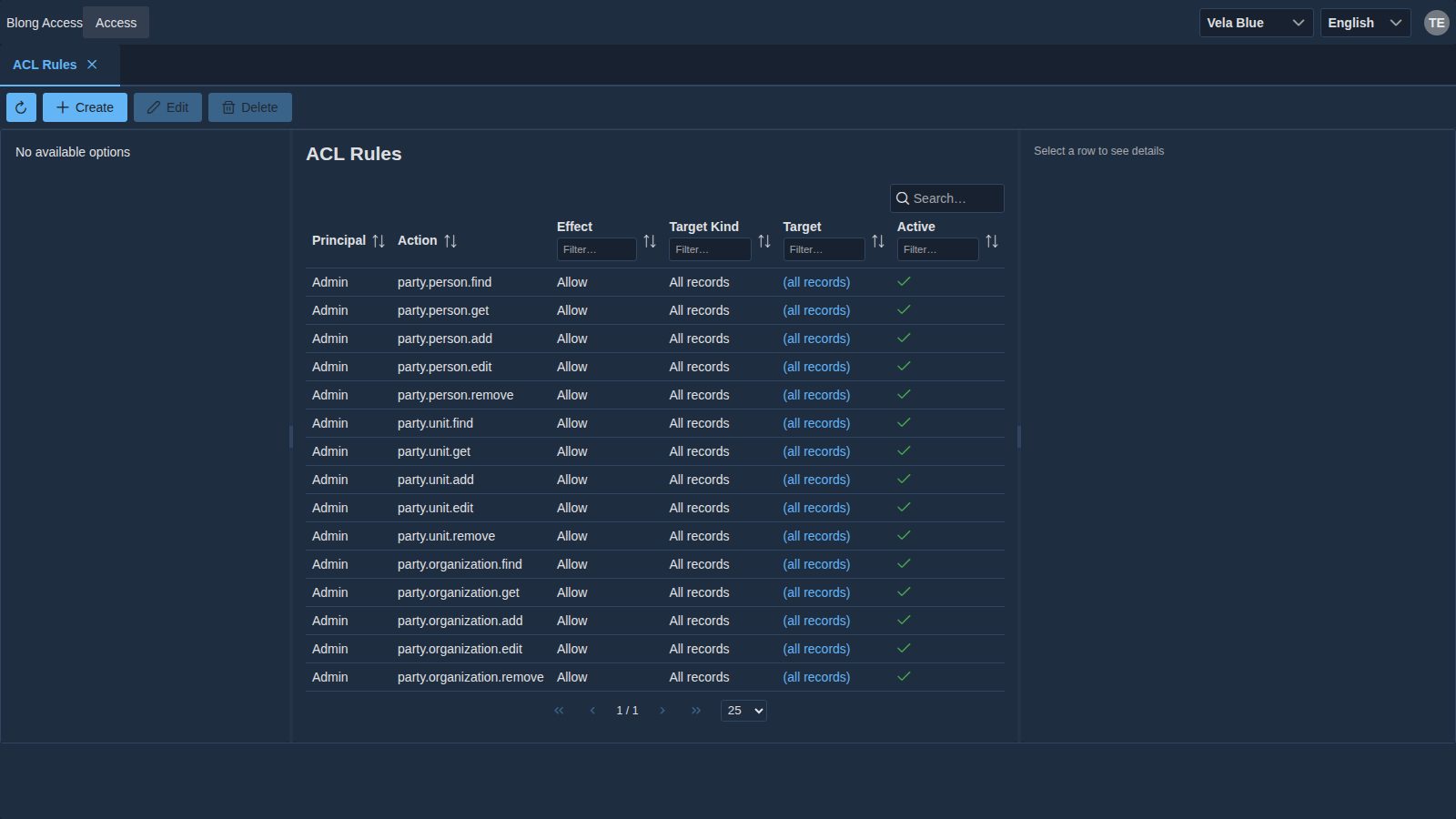
From the UI. ACL Rules (access.acl) is the explicit rule table: principal, action, target
kind, target, effect and active, with the names joined for display. The shared seed alone fills it —
Admin is allowed every guarded action on every record, while Manager is denied
party.person.find on one scope — so the wildcard and the deny are visible side by side:
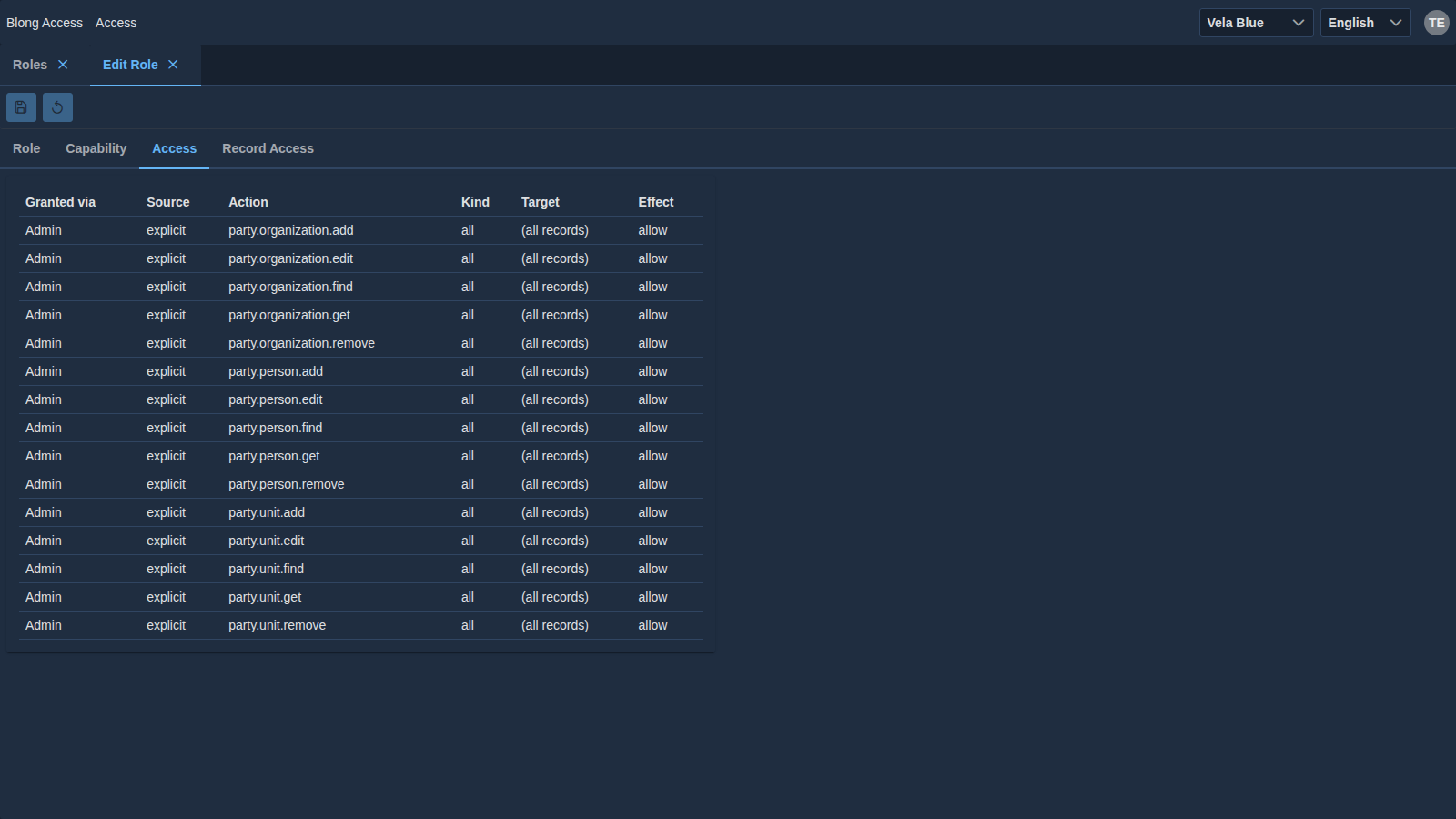
On a role or user, the Access tab lists the effective rules with the source of each decision — the same rules seen from the principal's side:
The Record Access matrix edits scope × verb as tri-state cells — clicking a cell cycles allow → deny → no rule, and a "no rule" cell removes the rule, which is how an implicit grant is narrowed back.
From seeds. The authorization merge accepts both halves:
# implicit organizational grants (the hasScope edge)
scope:
    - {role: Admin, scope: Head Office, scopeType: unit}
    - {user: testAdmin, scope: Global Bank Corp, scopeType: organization}

# explicit rules — a wildcard target matches every record
acl:
    - {
          principal: Admin,
          principalType: role,
          target: '*',
          effect: allow,
          actions: party.person.edit,
      }
    - {
          principal: testUser,
          principalType: user,
          target: Jane Smith,
          targetType: person,
          targetKind: record,
          effect: deny,
          action: party.person.get,
      }
| Field | Meaning |
|---|---|
principal / principalType | who the rule is for — user, role or unit (or a typeAlias) |
action / actions | the guarded action(s) by name (party.person.edit, or a comma-separated list) |
target / targetType | the record or scope; '*' means every record |
targetKind | record (default), scope, or all for the wildcard target |
effect | allow (default) or deny; a deny wins over an allow on a record inside a scope |
A rule's action must be the same identity as the guarded method: the runtime matches action names
with the dots removed, so party.person.edit and partyPersonEdit are one action, and a rule
pointing at a differently named duplicate would never apply.
From handlers. access.acl.add / .edit / .remove write single rules; the matrix on the role
and user pages is reconciled from the same helpers.
5. Ask inside a handler
export default handler(({handler: {accessAclAssert}}) => ({
    async invoiceInvoiceApprove(params: {invoiceId: string}, $meta: IMeta) {
        // Throws acl.notFound / acl.denied / acl.scopeDenied / acl.notPermitted.
        // `guarded: false` in the verdict means the entity opts out — proceed.
        await accessAclAssert({recordId: params.invoiceId, predicate: 'edit'}, $meta);
        // … proceed
    },
}));
access.acl.assert shares the SQL with the generic CRUD, so a manual check and the automatic one
can never disagree. this.aclCheck({recordId}, $meta) returns the same verdict from the adapter
side without throwing.
6. Custom deletes
A custom remove must delete the rules that name the record before deleting the record.
access_acl holds foreign keys to core_resource, so a delete that removes the entity row first
and then fails on a rule leaves a resource-only ghost — and because a resource is matched by name,
that entity can never be created again under its own name. The runtime's generic remove already
releases the rules, so a custom one only has to do the same when it bypasses the generic path.
7. Test it
- Grant, then assert every path: a denied record is filtered out of
find, reads asacl.notFoundonget, is refused oneditwithacl.denied, and anaddoutside the scope fails withacl.scopeDenied— each call passing$meta.expect: ['<error>']and asserting the thrown error'stype. - Prove the write, not just the read: write a rule through the UI path (the matrix), read it
back through the record's
get, and then prove a write that the rule denies is actually refused — that is the round triprealm/blong-party's ACL flow performs. - Guard against leftovers: a role that owns rules cannot be deleted until they are released, so a test that creates rules should end by clearing them (or deleting the record through the runtime).
The access matrix
For a whole hierarchy, one Data Table says more than a list of assertions. realm/blong-party
writes the org chart in the first column of the table, one column per person, and reads each cell as
the verdict of a real party.person.get through the gateway:
| viewer        | Amy | Ben | Cam | Fay | notes                      |
| ├── Axis HQ   | ·   | ·   | ·   | ·   | North and South are inside |
| │   ├── Amy   | ✅  | ✅  | ❌  | ❌  | implicit grant on North    |
| │   ├── Ben   | ✅  | ✅  | ❌  | ❌  | implicit grant on North    |
| │   └── Cam   | ✅  | ❌  | ✅  | ❌  | in scope; Ben denied       |
|     └── Fay   | 🚫  | 🚫  | 🚫  | 🚫  | no `party.person.get`      |
✅ is allowed, ❌ denied (acl.notFound), 🚫 refused by RBAC (403) and · a structural row
that is not a viewer. The probe has to go through the gateway — RBAC is a gateway preHandler, so an
in-process call answers acl.notFound where the gateway answers 403, and the RBAC row would be
invisible. See browser/test/feature/aclMatrix.ts in realm/blong-party, the aclMatrix helper
beside it and the cucumber pattern for the Data Table step.
Two records in that fixture exist only for the hole
the decision matrix describes — a record that takes part in no scope, where the guard short-circuits
to ALLOW. Hal is a person in no unit (verdict = unscoped ? ALLOW : guarded), and Ivy
holds a role that denies every record while being scoped like matrixAxis (so the deny has a grant
to beat). Their columns and rows say three things that are hard to see any other way:
| viewer | Amy | Ben | Cam | Dee | Fay | Gil | Hal | Ivy |
| Amy    | ✅  | ✅  | ❌  | ❌  | ❌  | ❌  | ✅  | ✅  |   the deny that names Hal is ignored
| Ivy    | ❌  | ❌  | ❌  | ❌  | ❌  | ❌  | ✅  | ❌  |   deny all — and the hole on Hal alone
Any viewer that holds the read sees Hal (his column is the same for all of them, whatever their
grant), a record deny naming him does nothing, and a wildcard deny does not close the hole either.
Ivy also denies herself, because her own record is inside the scope her rule covers — which is
what a deny means.
The service-account matrix
An organization or unit can be the caller: access.user.merge attaches an access_user profile to
the resource itself (so the profile's userId IS its resourceId), sets a clientId, and
access.credential.add writes its clientSecret. The account then authenticates with the OAuth
client_credentials grant — no session — and the minted token's sub is that resource id, so the
same narrowing applies. realm/blong-party asserts three more tables this way, one per guarded
shape (persons, units, organizations):
| viewer        | Amy | Ben | Cam | Dee | Fay | Gil | notes                                   |
| Axis          | ❌  | ❌  | ❌  | ❌  | ❌  | ❌  | grant ↦ Axis: no person scope holds one |
| ├── Axis HQ   | ✅  | ✅  | ✅  | ❌  | ✅  | ❌  | grant ↦ Axis HQ (and inherits Axis)     |
| │   ├── North | ✅  | ✅  | ❌  | ❌  | ❌  | ❌  | grant ↦ North (and inherits Axis)       |
| │   └── South | ❌  | ❌  | ✅  | ❌  | ✅  | ❌  | grant ↦ South (and inherits Axis)       |
| Beta          | 🚫  | 🚫  | 🚫  | 🚫  | 🚫  | 🚫  | no read capability                      |
| └── East      | ❌  | ❌  | ❌  | ✅  | ❌  | ✅  | grant ↦ East                            |
Two properties of the model show up here, because belongsTo is the inheritance edge in both
directions:
- a unit inherits the roles of the organization it belongs to (
access.effectiveRole, its second branch), and the actor's principals include the units it belongs to and their ancestors — so an account under a granted organization passes the gateway's action check even when its own role grants no read, and a🚫row needs an account with no granted ancestor; - a grant that names a unit covers the persons in it, not the unit record: a unit declares only
belongsToas its scope predicate (itsisPartOfparent is not a scope), so a unit record's scope set is the organization it belongs to plus that organization's ancestors — which is why the unit and organization tables are mostly❌, and only a grant naming the organization (or a parent of it) reaches them.
The application matrix
A third kind of caller is an OAuth application. gateway.application.merge (a dbTest handler in
realm/blong-gateway) creates the resource and a client secret, gateway.subscription.merge
subscribes it to a bundle — and a bundle IS an access.role — so the application's authorization is
its bundle's scope, the same narrowing a user's role gets. It authenticates with the
client_credentials grant (no session), and realm/blong-party asserts the same three tables per
application:
| viewer      | Amy | Ben | Cam | Dee | Fay | Gil | notes                                    |
| axis-app    | ❌  | ❌  | ❌  | ❌  | ❌  | ❌  | bundle ↦ Axis: no person scope holds one  |
| axis-hq-app | ✅  | ❌  | ✅  | ❌  | ✅  | ❌  | bundle ↦ Axis HQ; Ben carries a deny rule |
| north-app   | ✅  | ✅  | ❌  | ❌  | ❌  | ❌  | bundle ↦ North                            |
| south-app   | ❌  | ❌  | ✅  | ❌  | ✅  | ❌  | bundle ↦ South                            |
| beta-app    | ❌  | ❌  | ❌  | ❌  | ❌  | ❌  | bundle ↦ Beta                             |
| east-app    | ❌  | ❌  | ❌  | ✅  | ❌  | ✅  | bundle ↦ East                             |
| any-app     | ✅  | ✅  | ✅  | ✅  | ✅  | ✅  | allow rule on every record                |
| none-app    | 🚫  | 🚫  | 🚫  | 🚫  | 🚫  | 🚫  | no subscription: no capability            |
The contrast with the accounts above is the point: an application is not in the org chart, so it
inherits nothing. north-app reads North's persons and no others, where the North account also
reads everything the organization it belongs to covers. This is also the table where a unit-scoped
grant shows its limit twice: axis-hq-app reads the persons of Axis HQ, and no unit record at all —
a unit bundle cannot read the unit it is named after. The fixture is
browser/test/feature/aclMatrixApplication.ts in realm/blong-party, with
browser/test/test/testAclMatrixApplication.ts beside it.
The rules matrix — the table that declares no acl at all
The matrices above narrow because their tables declare an acl. The clearest way to say what that
declaration costs is a matrix over a table that does not have one, holding the records that do the
narrowing. access.acl is seeded in this suite and declares nothing, so it reads accessAclFind —
whose rows carry the joined targetName, which is what a column can name:
| viewer | Ben | Hal | (all records) | notes                                            |
| Amy    | ✅  | ✅  | ✅            | the deny on Hal is readable by its target too     |
| Ben    | ✅  | ✅  | ✅            | the rule that takes Ben back is readable by Ben   |
| Ivy    | ✅  | ✅  | ✅            | her deny names party.person.get, not this table   |
| Cam    | ✅  | ✅  | ✅            | her record exemption is public                    |
| Fay    | 🚫  | 🚫  | 🚫            | matrixNone: no access.acl.get (the only refusal)  |
| Dee    | ✅  | ✅  | ✅            |                                                  |
| Gil    | ✅  | ✅  | ✅            | the wildcard allow is not what admits this read   |
Two details the shape teaches. A column is the record a rule targets (Ben, Hal, the sentinel
the wildcard rules share, which the ACL page labels (all records)) — a role's scope is a grant
on the role, not a rule target, so North and Axis HQ are not columns. And the table is named by
a joined field the ACCESS_ACL table does not hold, so the target resolves the name in code, on
the rows the find returned, rather than through filterBy: a virtual name is not a column a WHERE
clause can reach (the access realm's own Browse page searches description for that reason). That
is the nameColumn alternative on IAclMatrixTarget.
The explicit-mode matrix
party.consent is the table that declares acl: {mode: 'explicit'} and no scopes, which
makes it the deny-by-default shape: no hasScope grant is consulted, and no scope set is built, so
only a record-targeted or all-targeted allow can admit a row. Its fixture is two rules — one
record allow for matrixNorth, one scope allow for matrixAxis that has nothing to match — plus
the wildcard allow matrixAll already carries:
| viewer | Amy marketing | Beta research | Cam study | notes                                      |
| Amy    | ✅            | ❌            | ❌        | matrixNorth admits that one record         |
| Ben    | ✅            | ❌            | ❌        | the same role, so the same one record      |
| Ivy    | ✅            | ❌            | ❌        |                                           |
| Cam    | ❌            | ❌            | ❌        | her allow names a scope: no scope set here |
| Fay    | 🚫            | 🚫            | 🚫        | matrixNone: no party.consent.get          |
| Dee    | ❌            | ❌            | ❌        | owns a consent, still may not read it      |
| Gil    | ✅            | ✅            | ✅        | the wildcard allow reaches every row       |
The rows are the same seven viewers as the person matrix and the columns are the three seeded
consents (20-aclMatrix-partyHierarchyMerge.yaml), each owned by a person through the declared
belongsTo edge — Dee owns Beta research and still reads nothing, which is what deny-by-default
means once the implicit grant is switched off. The scope rule is not "ignored because the mode is
explicit": it matches nothing because the table declares no scopes, so aclCheckSql never builds
a scope set for it to reach. Declaring scopes: ['belongsTo'] would give that rule something to
match (a consent's scope set is its owner) without changing the mode.
What has no matrix
add and addScope are asserted by the server-side flow rather than by a matrix, and deliberately:
a matrix probes a record, so a write row would have to create a record per cell — a table that
writes as it reads, and a fixture that grows with every cell. The in-process flow (adapter/test/…
in realm/blong-party, group test.acl.flow) drives party.person.add with a submitted
belongsTo edge instead and asserts the scope the guard resolved from the payload. The same
reasoning applies to anything else whose probe is a mutation: assert it where the state is already
under test, and keep the matrix for reads.
Asserting the fixture the matrix is built from
An outcome table says nothing about why a cell is what it is, and its expectations encode a model
of the fixture — which is exactly where a mistake hides. Each matrix therefore opens with a
Background that asserts the records the access is derived from, so the file reads on its own:
Background:
  Given the ACL org chart is
    | record      | kind | belongsTo | isPartOf | notes                           |
    | Axis        | org  |           |          | the granted organization        |
    | ├── Axis HQ | unit | Axis      |          | North and South are isPartOf it |
    | │   ├── Amy | person | North   |          |                                 |
    …
  And the ACL users are
    | record | kind | hasRole     | notes                           |
    | amy    | user | matrixNorth | Amy is the person, amy the user |
    …
  And the ACL grants are
    | principal   | kind | hasScope | hasCapability              |
    | matrixNorth | role | North    | loginCapability,matrixView |
    …
  And the ACL rules are
    | principal  | kind | effect | actions          | target |
    | matrixAxis | role | deny   | party.person.get | Ben    |
    | matrixAll  | role | allow  | matrixView       | *      |
The shape is the point: every column is one predicate (belongsTo, isPartOf, hasRole,
hasScope, hasCapability, plus clientId for a service account), so a cell is a claim about the
graph rather than a comment, and one engine asserts all of it. party.fixture.get reads the facts
back by name (adapter/dbTest/partyFixtureGet.ts in realm/blong-party), the aclFixture library
compares them (browser/test/test/aclFixture.ts), and an actions cell may name a capability whose
actions the rule covers. A cell states every target of that subject and predicate, so an edge
the fixture does not declare fails the table instead of passing unnoticed — which is how a stale
leftover capability from an earlier iteration of the fixture was found.
Two conventions make the tables readable. A user is named after its person in lower case (Amy the
person, amy the user) — two records, and the case tells them apart. And the Background is
asserted once per feature but runs before every scenario, so the service-account and application
features do not repeat their fixture three times.
Two things about the exposure are worth knowing before adding a read of your own. The generic CRUD
methods are reachable over RPC because the table has a model in meta/model/ (model(...)
registers subject, object and the predicate set) — declaring the table in meta/db/db.ts creates it
without an API, and a table without a model answers 404 Not Found however the call is made. And
the method name must be three words — methodParts (core/blong-gogo/src/lib.ts) splits subject,
object and predicate out of the handler name and glues a fourth word onto the predicate
(partyAclFixtureGet → party.acl.fixtureGet).
The harness that resolves the columns is a caller like any other, so a new matrix needs both
levels of read for testAdmin: the action in its capability (matrixHarnessRead), and — on a table
that declares an acl — a record-level allow, because RBAC and the record level are separate
questions. Give the harness user its own rule rather than appending a second action to the role's
wildcard allow: the seed merge appends to an existing rule's action list, so a role-targeted rule
would quietly rewrite a list that belongs to the access realm (and the rules table would then
rightly fail, since a fixture cell states every action a rule carries).
Reading a red run
A matrix is a table of refusals, so a green run writes an error-level entry per ❌ and 🚫 cell
unless the probe says otherwise. Every probe therefore declares what it is prepared for —
expect: ['acl.notFound', 'gateway.notAllowed'], and gateway.notAllowed alone for the fixture
read — which is what keeps the suite's error stream empty: realm/blong-party went from 467 entries
per run to none, and the entries that remain are the failures nobody asked for. See
expected errors for the matching rules and the three things that
have to line up for a declaration to be honoured through the gateway.
When a cell does not match, the step asserts once with the redrawn table as its message: the table
is framed and padded, the offending cell reads expected≠actual, and every mismatch is also named —
row, column, both values — underneath. That report is a contract, so it is tested: the
test.acl.diagnostics feature (group test.acl.diagnostics in realm/blong-party) drives the real
helpers with a deliberately wrong table and asserts that each mismatch is marked in the cell it
belongs to, and that a table with nothing wrong reports nothing. Change the marker and that feature
fails, which is the point.
8. Troubleshooting
| Symptom | Likely cause |
|---|---|
| A rule seems to have no effect | its action resource is a different resource with the same dot-stripped name — write rules through the matrix, which resolves the action the same way the runtime does |
| Everything is visible after enabling the guard | the records are in no scope: check the scopes predicates and that the access.effectiveScope path was refreshed |
| An organization's records are always hidden | selfScope has no RBAC fallback: the caller needs a grant naming the organization or a parent |
| The matrix lists rows you did not expect | its rows are every graph resource of the listed types — filter the Scope column |
| A column reports no record id, or a table is empty | the harness cannot read the table: add the action to matrixHarnessRead and, on a guarded table, a record-level allow naming the harness user |
A rule's actions cell fails with a longer list | the seed merge appends to an existing rule — a role-targeted rule lands on the access realm's own wildcard allow; target the harness user instead |